Certification claims are cheap to make and expensive to get wrong. A supplier quote sheet that lists "ASTM F1918 compliant" or "SGS certified" next to a product photo tells a buyer almost nothing on its own — the question that determines real exposure is whether that claim can be independently confirmed before a purchase order is signed, not after an incident, an insurance audit, or a franchise inspection forces the question.
The cost of an unverified claim does not fall on the supplier. It falls on the operator holding the equipment, the developer whose tenant mix depends on it passing a mall's liability review, and the investor whose underwriting assumed the documentation was real. Certification review is also not a one-time event that happens at the moment of purchase — it resurfaces at insurance renewal, at franchise inspection, at lease review, and at resale, each time requiring the same underlying documentation to hold up under scrutiny. A supplier relationship built on an unverified claim doesn't fail quietly; it fails at the exact moment the documentation is needed most.
This guide breaks ASTM F1918 down into what it actually tests, walks through how to authenticate an SGS certificate or test report line by line, and compares the practical risk exposure across three supplier documentation tiers — no certification, self-declared certification, and independently verified third-party certification.
ASTM F1918, formally the Standard Safety Performance Specification for Soft Contained Play Equipment, is the standard specific to soft-contained play structures — the ball pits, crawl tubes, netted climbers, foam-covered obstacles, and enclosed multi-level play systems typically found in indoor FECs, mall play areas, and quick-service restaurant play zones. It is issued and maintained by ASTM International, under the jurisdiction of Committee F15 on Consumer Products and its Subcommittee F15.36 on Soft-Contained Play Systems.
This distinction matters more than it looks. ASTM F1918 is not the same standard as ASTM F1487, which governs public outdoor playground equipment, and it is not the European equivalent EN 1176/1177. A supplier who cites "ASTM" compliance without specifying which standard, or who substitutes F1487 documentation for a soft-contained product, is either careless or misrepresenting the product's compliance basis. Soft-contained play equipment has different failure modes than rigid outdoor structures — entrapment inside netting or tubing, foam material flammability, and enclosed-space evacuation are all conditions unique to the indoor soft-play format — which is precisely why a dedicated standard exists.
The standard's scope is specific and worth reading literally rather than taking on trust. ASTM F1918 applies to soft contained play equipment intended for users ranging from the 5th percentile 2-year-old to the 95th percentile 12-year-old. It explicitly excludes public playground equipment, home playground equipment, sports equipment, amusement rides, fitness equipment not part of the play system, water-related attractions, and toys or juvenile products. If a supplier's documentation covers any of those excluded categories, it is not evidence of F1918 compliance for a soft-contained play structure.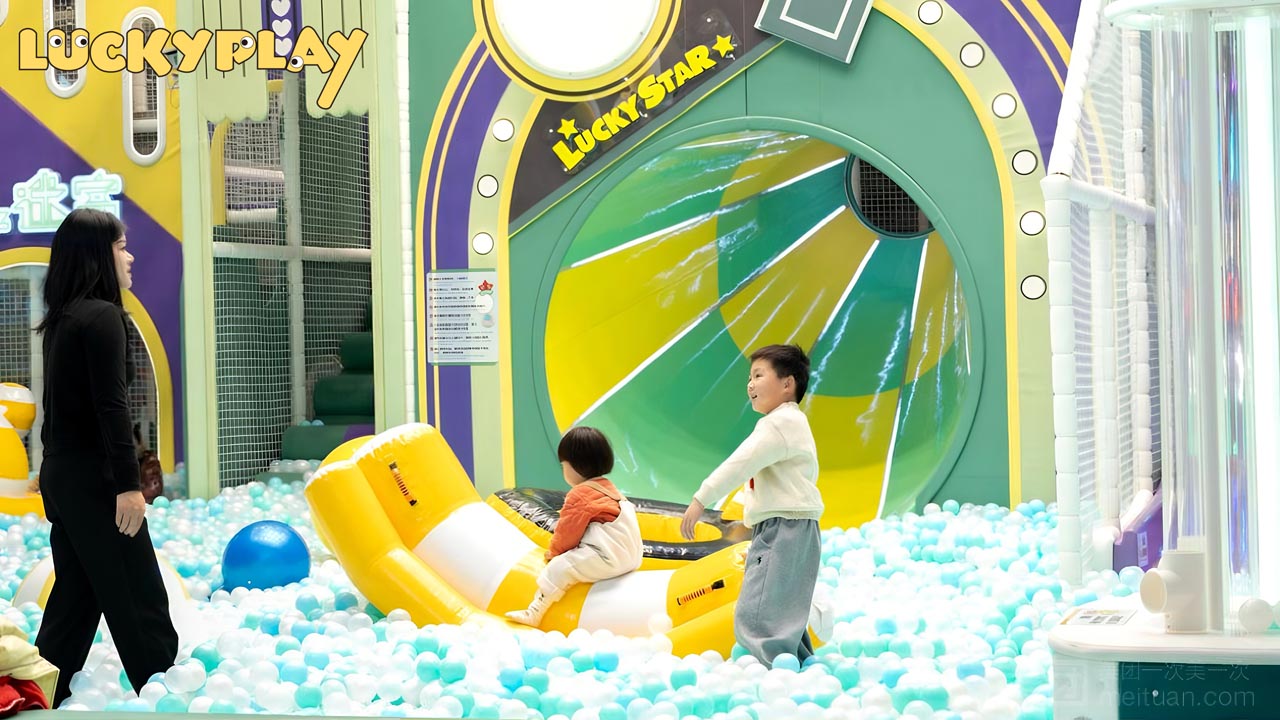
F1918 is organized into defined sections, and a legitimate test report will reference these sections directly rather than making a single blanket compliance statement. For a procurement team, understanding what each section actually audits is what turns "ASTM F1918 compliant" from a marketing line into a checkable claim:
Two further details matter for procurement teams specifically. First, F1918 is periodically revised — the current edition is F1918-21, superseding earlier versions including F1918-12 (2017) — and a report citing an outdated edition without explanation should prompt a direct question about why. Standards bodies revise specifications precisely because testing methodology, hazard understanding, and material science evolve; a manufacturer testing against a lapsed edition is not necessarily acting in bad faith, but the buyer should know which edition applies to the product being purchased and why.
Second, F1918 compliance and ongoing facility compliance are not the same thing. Passing laboratory testing at time of manufacture establishes that a product met the standard's design and performance criteria when tested. It does not, on its own, establish that the same unit remains compliant after months or years of operational wear, cleaning, and repair — which is exactly why the standard's Maintenance section exists as a distinct, ongoing obligation rather than a one-time checkbox. A facility that installed compliant equipment three years ago and never implemented the manufacturer's required inspection and maintenance protocol is not automatically still in compliance today; that is a separate audit question buyers and operators need to track after installation, not just verify at the point of purchase.
The operative point for a buyer: F1918 compliance is verified through laboratory testing against these defined sections, not asserted through a single-line claim on a spec sheet. A test report that cites the standard without referencing which sections were tested, what the pass/fail outcome was per section, and what specific product was tested is not evidence of compliance — it is a claim awaiting verification.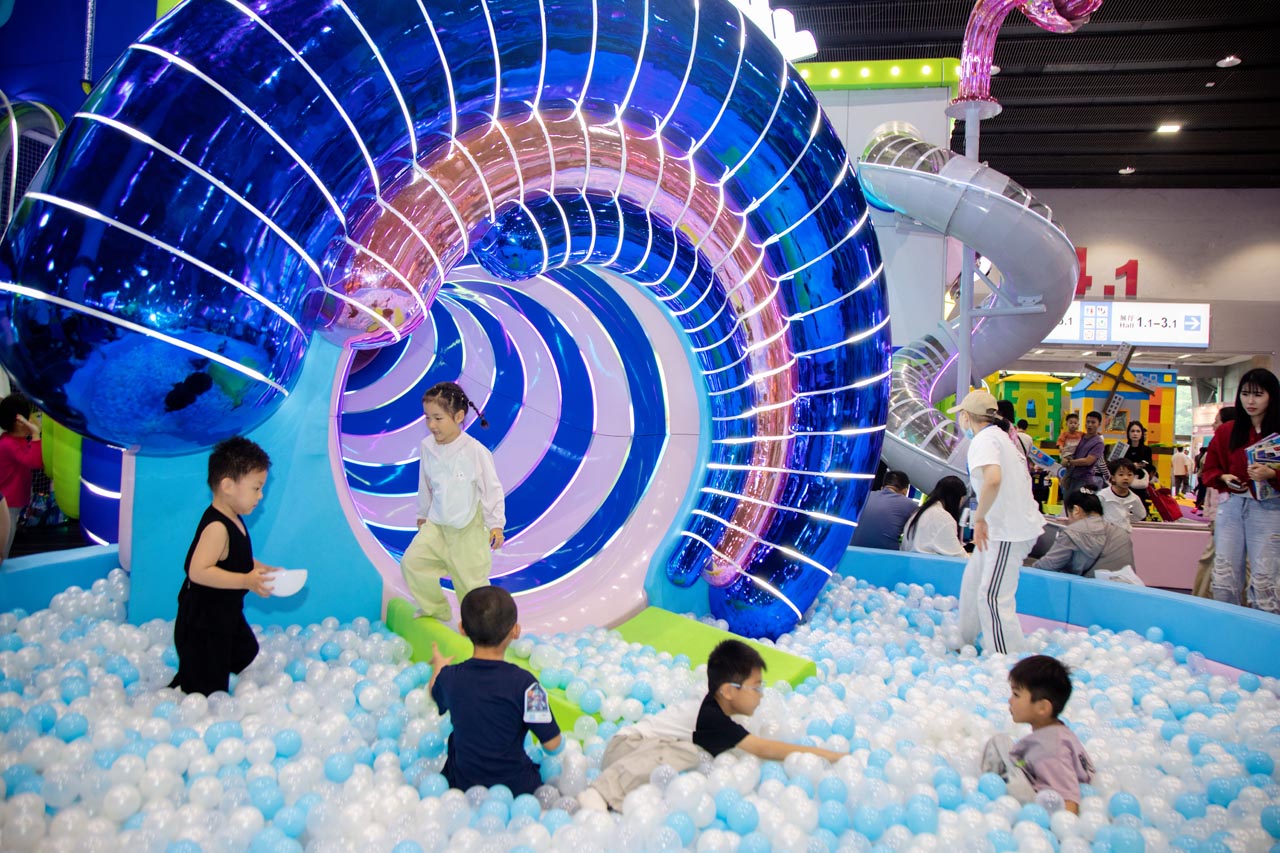
SGS is a third-party testing, inspection, and certification (TIC) body. It does not manufacture play equipment, which is exactly what gives an SGS report evidentiary weight that a manufacturer's own internal test results cannot carry on their own — a report bearing SGS's name represents an assessment performed by a party with no commercial stake in the product passing.
That said, third-party branding on a document is not self-authenticating. Counterfeit and misused SGS branding exists in the market, which is why SGS maintains its own verification channels, and a procurement team should treat running a document through them as a standard step rather than an optional one. SGS itself states plainly that it checks thousands of documents each year specifically to identify counterfeit or misused branding, and that when counterfeit documents are found, it investigates and takes action against the individuals or organizations behind them — which is a reasonable indication that the risk, while representing a minority of documents in circulation, is real enough that the issuing body maintains a standing verification infrastructure for it.
It's also worth distinguishing between the different documents a supplier might present, since they carry different weight. A test report documents specific results against specific clauses of a named standard for a specific product sample — this is the most substantive document and the one worth requesting in full rather than accepting a summary of. A certificate is typically a shorter, standardized document confirming that a product or facility meets defined criteria, often referencing an underlying test report. A compliance letter or declaration of conformity, by contrast, is frequently a supplier-authored statement that may or may not reference third-party testing at all — it should not be treated as equivalent to a test report or certificate unless it explicitly cites one.
A five-step verification checklist:
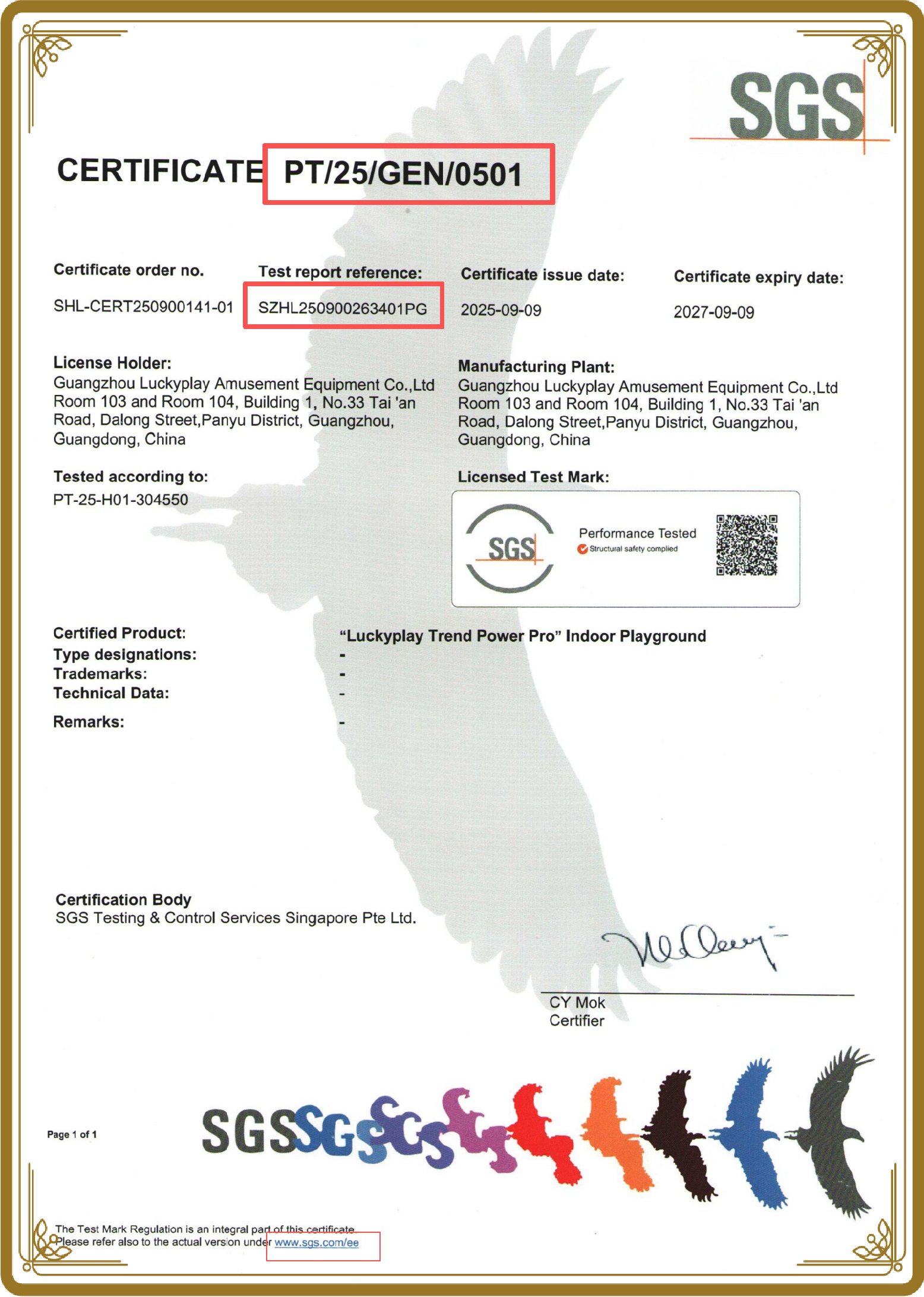
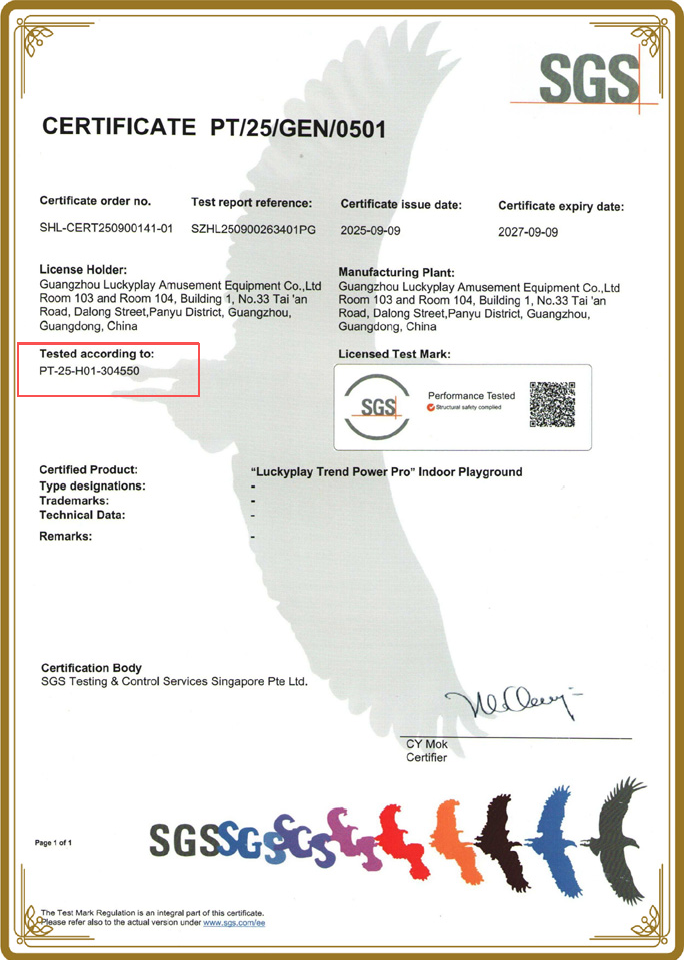
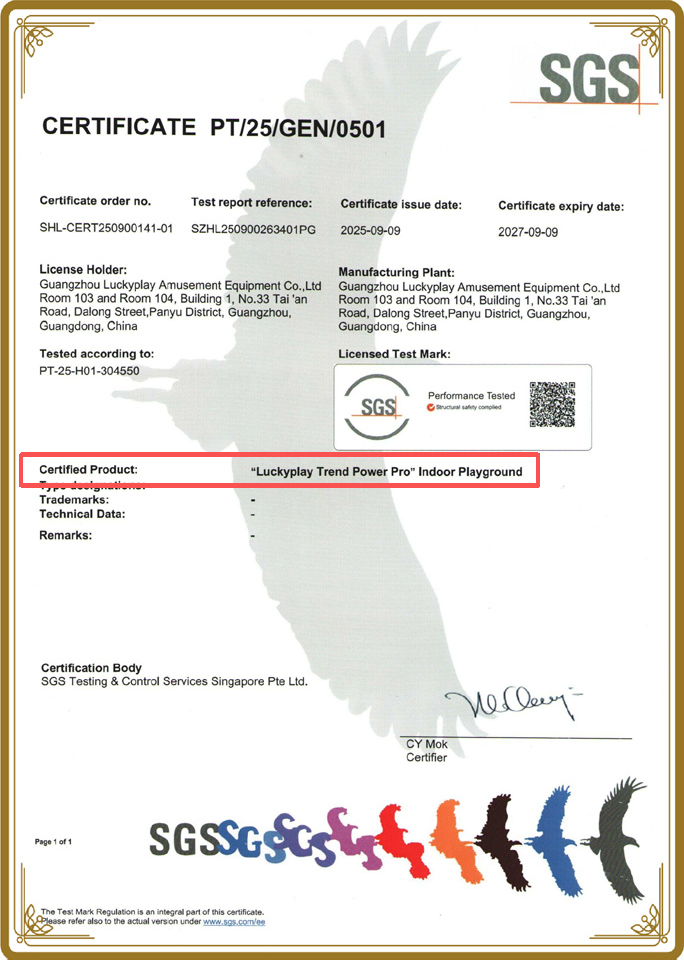
A genuine SGS soft play equipment test report will typically present the following fields, and it's worth knowing what to look for even before a screenshot example is available: a report or certificate number positioned in the document header; the issuing SGS branch or laboratory location; the client (manufacturer) name and registered address; a specific product description or model number; the standard and test method referenced, including edition year; the date testing was performed and the date the report was issued; a conformity or pass/fail statement broken out by clause or section rather than a single blanket statement; and an authorized signatory alongside the SGS accreditation mark. A document missing several of these fields warrants a verification request before it's treated as adequate documentation.
Supplier documentation for soft play equipment generally falls into one of three tiers, and each carries a materially different risk profile for the buyer — not just a different level of assurance, but a different allocation of who bears the consequences if a safety claim turns out to be false.
No certification or documentation offered. Some suppliers provide no safety documentation at all, or offer it only verbally. In this tier, the buyer has no independent basis for any safety claim made about the product. If an incident occurs, an insurer disputes a claim, or a landlord or franchisor requires proof of compliance during a lease or franchise audit, the buyer has nothing to produce. Liability exposure sits entirely with the buyer, because there is no third-party record establishing that due diligence was performed at the time of purchase.
Self-declared or manufacturer-issued "certification." A supplier tests its own product internally, or references a standard without providing an independent lab's report, and issues its own compliance documentation. This is first-party testing — the same party has a direct commercial interest in the outcome and control over how the results are documented. It is not inherently false, but it does not carry the evidentiary weight of independent verification, and it will typically not satisfy insurance underwriters, franchisors, or landlords who specifically require third-party proof. Buyers relying on self-declared documentation should expect to be asked, during any formal review, whether an independent lab was involved — and should have an answer ready before that question comes up rather than after.
Independent third-party certification. Testing performed by an accredited body with no commercial stake in the outcome — SGS or another ISO/IEC 17025-recognized laboratory — produces documentation that is independently verifiable through the issuing body's own channel, as described above. This is the only tier where a buyer can confirm the claim's validity without relying on the supplier's word. It also tends to correlate with a broader quality and process discipline on the supplier's side: a manufacturer that has built independent verification into its standard sales process, rather than producing it only on request, is generally signaling that compliance documentation is a fixed part of its production workflow rather than a one-off accommodation for a specific deal.
The distinction between these tiers is not always obvious from a spec sheet alone, which is exactly why the verification steps in the previous section matter — a self-declared certification and a third-party certification can look identical in a sales presentation and only diverge when someone actually checks the certificate number against the issuing body's directory.
The practical consequences of each tier extend well beyond the moment of purchase. Insurance underwriting for indoor FEC operations frequently requires proof of equipment compliance with a recognized safety standard; contractual liability allocation in supplier agreements often turns on whether documented compliance was provided at time of sale; and franchise or resale valuation for an FEC business is directly affected by whether the equipment portfolio carries verifiable, transferable compliance documentation. In the event of an incident investigation, the presence or absence of independently verifiable certification is typically one of the first records requested.
These consequences compound across a facility's lifecycle rather than resolving after a single review. A developer negotiating a lease for an indoor FEC tenant will frequently require proof of equipment compliance as a condition of tenancy, independent of anything the operator's own insurer requires. A franchisor building out multiple locations from a single equipment supplier is exposed to the same documentation gap at every unit if the underlying supplier relationship was never verified at the outset — a self-declared claim that goes unchecked at the first location typically goes unchecked at the tenth. And a buyer evaluating an existing FEC business for acquisition is, in effect, inheriting whatever documentation tier the prior owner accepted; equipment purchased on a self-declared or undocumented basis becomes a valuation and diligence problem for the next owner, not just the original buyer.
None of this requires assuming bad faith on the supplier's part. Many suppliers offering only self-declared documentation are not misrepresenting anything — they may simply not have engaged a third-party lab, particularly for smaller production runs or newer product lines. The distinction that matters for a buyer is not intent but evidentiary weight: a claim a buyer cannot independently verify carries the same practical risk regardless of whether the supplier believes it to be true.
A due-diligence checklist for supplier evaluation:
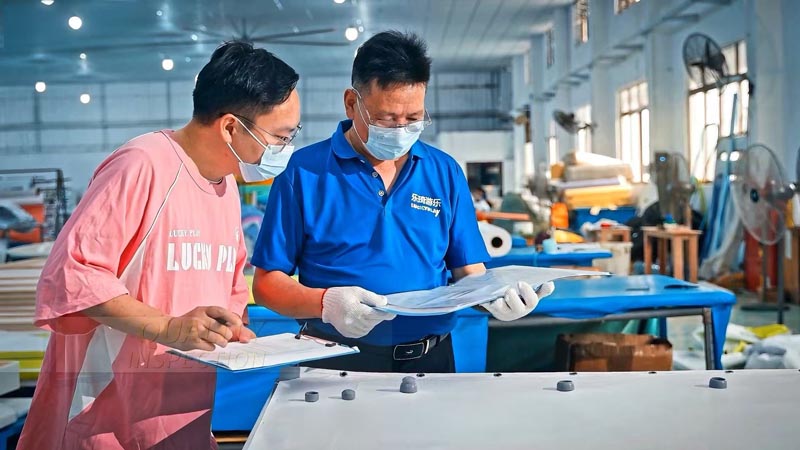
Certification claims are verifiable facts, not marketing language, and the cost of verifying them — a directory search, a document submission, a section-by-section read of a test report — is negligible compared to the cost of discovering an unverified claim was false after equipment is already installed and operating. Luckyplay, for example, maintains an in-house SGS QTL testing laboratory alongside independent third-party certification, reflecting the same layered verification approach outlined above: internal testing to catch issues early, and third-party validation to give buyers a claim they can independently confirm rather than one they have to take on trust. Whatever supplier a buyer ultimately selects, the discipline is the same — verify before the purchase order is signed, not after a claim is tested by an incident, an insurer, or an audit.


